Picture this: it's a foggy night in 1514, and somewhere off the English coast, a merchant vessel is desperately searching for safe harbour. The only thing standing between those sailors and the jagged rocks below is a flickering beacon maintained by a brand new organization called Trinity House. Fast forward exactly 500 years, and the Royal Mint decided to honour this incredible legacy with a £2 coin that tells one of Britain's most enduring maritime stories.
Chapter 1
The Story Behind the Coin
The Trinity House Lighthouse £2 coin emerged in 2014 as a tribute to one of Britain's oldest maritime institutions, Trinity House, which celebrated its 500th anniversary that year. Founded by Henry VIII in 1514 with a royal charter, Trinity House began as a guild for mariners but evolved into something far more vital: the guardian of Britain's coastal waters. For centuries, this remarkable organization has been responsible for maintaining lighthouses, buoys, and beacons around England, Wales, and the Channel Islands, quite literally keeping the lights on for countless sailors navigating treacherous waters.
The timing of this coin's release couldn't have been more perfect. As Britain reflected on its maritime heritage in 2014, the nation was reminded that Trinity House had guided everyone from Tudor merchants to modern container ships safely home. The organization's motto, 'Per Mare Per Terram' (By Sea By Land), speaks to their comprehensive approach to maritime safety, and this coin serves as a tangible reminder of how British ingenuity and dedication have protected seafarers for half a millennium.
For centuries, Trinity House has been quite literally keeping the lights on for countless sailors navigating treacherous waters.
YOU’RE INVITED!
Trade gold, silver, stocks & crypto on eToro
Joining through this invite supports Florin House. Capital at risk · T&Cs apply.
Chapter 2
The Design
The coin's design beautifully captures the essence of Trinity House's mission through carefully chosen maritime imagery. The reverse features the iconic Trinity House emblem, complete with their traditional lighthouse motif surrounded by nautical elements that speak to centuries of seafaring tradition. The designer managed to compress 500 years of maritime heritage into a space no larger than a ten pence piece, creating a miniature work of art that lighthouse enthusiasts and coin collectors alike can appreciate.
What makes this design particularly striking is how it balances historical gravitas with modern minting techniques. The intricate detailing showcases the Royal Mint's technical prowess, while the imagery connects us directly to those brave lighthouse keepers who once tended oil lamps in isolated towers, ensuring that every ship could find its way safely to shore. It's a design that works whether you're examining it through a magnifying glass or simply admiring it in your palm.
The designer managed to compress 500 years of maritime heritage into a space no larger than a ten pence piece.
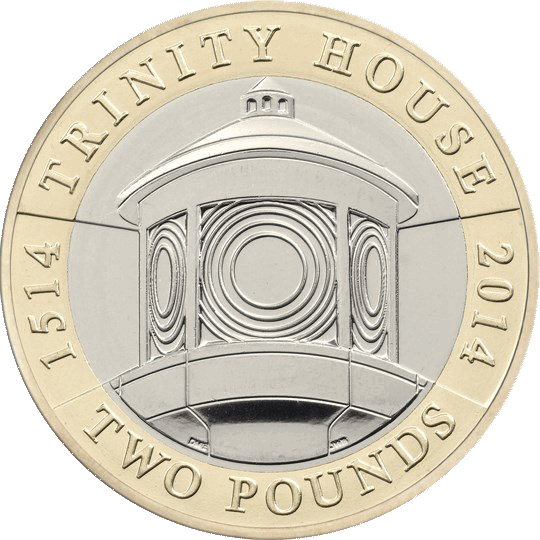
Obverse & reverse — click to flip
Chapter 3
Collector's Corner
Mintage
3,705,000
coins struck
Florin House Rarity
Uncommon
classification
Value
£2.00
estimated market
With a mintage of 3,705,000 pieces, the Trinity House Lighthouse £2 sits in that sweet spot that collectors love: accessible enough to acquire without breaking the bank, yet uncommon enough to feel special in your collection. You'll occasionally spot these coins in your change, though they're becoming increasingly scarce in everyday circulation as aware collectors snap them up. The relatively modest mintage means this isn't one of those commemorative coins that everyone forgot about after a few months.
For collectors focusing on maritime themes or British institutional history, this coin represents excellent value at face value. While it hasn't seen dramatic price appreciation yet, coins commemorating significant anniversaries of enduring British institutions often develop a devoted following over time. Keep an eye out for particularly well-struck examples, as the detailed design elements can vary noticeably in quality between individual coins, making crisp, clear specimens more desirable to serious collectors.
This coin sits in that sweet spot collectors love: accessible enough to acquire, yet uncommon enough to feel special.
Chapter 4
Did You Know?
Trinity House operates 66 lighthouses around England, Wales and the Channel Islands, many of which are now fully automated
The organization's headquarters at Trinity House London contains a remarkable collection of maritime artifacts and lighthouse lenses dating back centuries
Trinity House lighthouse keepers were among the last people in Britain to receive their wages in actual gold sovereigns, right up until the 1970s
The famous Eddystone Lighthouse, maintained by Trinity House, has been rebuilt four times since 1696 due to storms and fires, becoming a symbol of British engineering persistence
Explore this coin on Florin House
View detailed specifications, track its value, and add the Trinity House Lighthouse to your collection.
View Trinity House LighthouseWritten with AI assistance from the catalogue record for Trinity House Lighthouse.