Picture this: it's 1998, Tony Blair's New Labour is riding high, the Good Friday Agreement has just brought hope to Northern Ireland, and Britain seems more European than ever before. Into this optimistic moment, the Royal Mint released a special 50p coin celebrating the European Union - a small piece of metal that would, in hindsight, capture one of the most complex relationships in modern British history. Little did anyone know that this humble commemorative would become a fascinating artifact of a Britain that believed, however briefly, in its European future.
Chapter 1
The Story Behind the Coin
The late 1990s were heady days for European integration. The Euro was being prepared for launch, the EU was expanding, and Britain, despite staying out of the single currency, was still very much at the European table. Tony Blair's government was keen to show that Britain could be a good European partner, even if it kept the pound. The decision to issue this commemorative 50p was part of that careful balancing act - celebrating European unity while maintaining British sovereignty through its own currency.
What makes this coin particularly poignant is how it captures a moment of genuine optimism about Britain's place in Europe. This wasn't the reluctant, semi-detached relationship that would later define British-EU relations. In 1998, there was still real belief that Britain could be both proudly British and enthusiastically European. The Royal Mint struck over five million of these coins, sending them into everyday circulation where they would sit alongside Britannias and lions, quietly normalizing the idea of European identity in British pockets.
This humble commemorative would become a fascinating artifact of a Britain that believed, however briefly, in its European future.
YOU’RE INVITED!
Trade gold, silver, stocks & crypto on eToro
Joining through this invite supports Florin House. Capital at risk · T&Cs apply.
Chapter 2
The Design
The coin's design speaks the universal language of institutional optimism - clean lines, symbolic imagery, and that particular kind of hopeful modernism that characterized late 20th-century commemoratives. The reverse features a stylized representation of European unity, with interlocking elements that suggest cooperation and shared purpose. It's the kind of design that looks diplomatic and safe, carefully avoiding anything too bold or provocative that might upset either Europhiles or Eurosceptics.
What's fascinating is how restrained the European imagery is. This isn't a coin that shouts about European integration - instead, it whispers about partnership and cooperation. The designers clearly understood they were walking a tightrope, creating something that could celebrate European ideals without alienating a British public that was always somewhat ambivalent about the European project. Looking at it now, there's something almost wistful about its measured optimism.
The designers clearly understood they were walking a tightrope, creating something that could celebrate European ideals without alienating a British public.
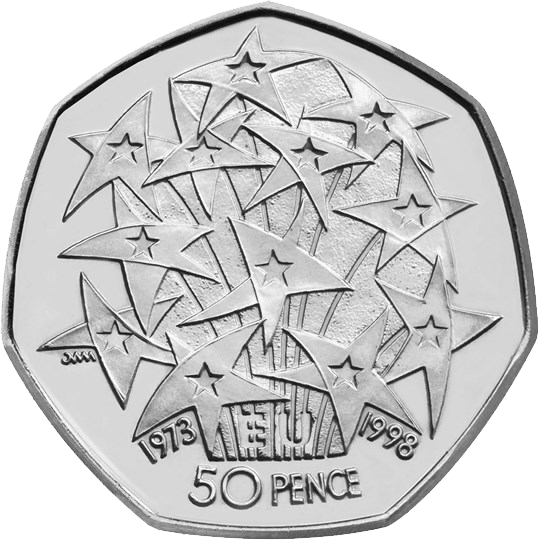
Obverse & reverse — click to flip
Chapter 3
Collector's Corner
Mintage
5,043,000
coins struck
Florin House Rarity
Uncommon
classification
Value
£1.50
estimated market
With over five million minted, this isn't a coin you'll struggle to find, but its historical significance has kept collector interest steady. Brexit has given these coins an entirely new context - they're no longer just commemoratives, they're artifacts from a different Britain. You'll often find them in circulation, though many collectors are quietly setting aside nice examples as the political significance becomes clearer with each passing year.
The market value of £1.50 might seem modest, but remember that's triple the face value for what was essentially a common coin just a few years ago. Look for examples in uncirculated condition, as these will likely appreciate more significantly over time. The real value here isn't necessarily monetary - it's historical. These coins are becoming tangible reminders of a pivotal moment when Britain's European story could have gone very differently.
Brexit has given these coins an entirely new context - they're no longer just commemoratives, they're artifacts from a different Britain.
Chapter 4
Did You Know?
1998 was the same year the Euro currency was officially established, making this UK coin a curious parallel to continental monetary integration
These coins circulated alongside the last pre-decimal pennies, which were finally withdrawn from circulation in 1971 but occasionally still turned up in change
Tony Blair's government issued this coin while simultaneously ruling out joining the Euro without a referendum - a contradiction that perfectly captured Britain's complex European relationship
The Royal Mint has never issued another coin specifically celebrating the European Union, making this the only UK coin of its kind
Explore this coin on Florin House
View detailed specifications, track its value, and add the European Union to your collection.
View European UnionWritten with AI assistance from the catalogue record for European Union.