Picture this: you're rummaging through your change after a trip to the shops, and there it is—a spiraling double helix gleaming back at you from a £2 coin. This isn't just any commemorative piece; it's the Royal Mint's tribute to one of humanity's greatest scientific breakthroughs. In 2003, fifty years after Watson and Crick first mapped the structure of DNA, the Royal Mint decided that this monumental discovery deserved a place in our pockets alongside kings and queens.
Chapter 1
The Story Behind the Coin
The year 2003 marked a double celebration in the scientific world. Not only was it the 50th anniversary of Watson and Crick's earth-shattering revelation about DNA's double helix structure, but it also coincided with the completion of the Human Genome Project—humanity's first complete genetic map. The Royal Mint, recognizing that this discovery had fundamentally changed medicine, forensics, and our understanding of life itself, knew they had to commemorate this milestone in a special way.
What makes this story even more compelling is the timing. By 2003, DNA testing was revolutionizing criminal investigations, paternity cases were being resolved with unprecedented accuracy, and gene therapy was offering hope for previously incurable diseases. The Royal Mint wasn't just celebrating a dusty academic achievement—they were honoring a discovery that was actively changing lives every single day. This £2 coin represents the moment when science truly entered the public consciousness, when the double helix became as recognizable as any national symbol.
This £2 coin represents the moment when science truly entered the public consciousness
monzo
Switch & get a mystery reward of £20, £50 or £100
Free UK bank account, opened in minutes — joining through this link supports Florin House. New customers · T&Cs apply.
Chapter 2
The Design
The coin's reverse features an elegantly stylized representation of the DNA double helix, with the iconic twisted ladder structure rising majestically across the coin's face. The design captures the mathematical beauty of genetics—those precise, spiraling strands that carry the instructions for all life on Earth. What's particularly clever about this design is how it transforms complex molecular science into something visually striking and accessible to everyone.
Surrounding the helix, you'll find the inscription marking the 50th anniversary of the discovery, grounding this scientific marvel in its historical moment. The designers managed to balance scientific accuracy with artistic appeal, creating a coin that would make both geneticists and collectors smile. It's remarkable how they've taken something invisible to the naked eye—something you need powerful equipment to actually see—and made it the star of a coin that millions would carry in their pockets.
The designers transformed something invisible to the naked eye into the star of a coin carried by millions
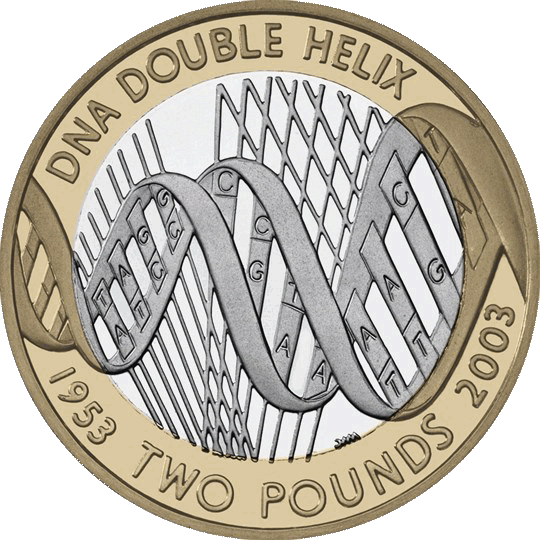
Obverse & reverse — click to flip
Chapter 3
Collector's Corner
Mintage
4,299,000
coins struck
Florin House Rarity
Uncommon
classification
Value
£2.00
estimated market
With over 4.2 million coins minted, the DNA Double Helix £2 sits comfortably in that sweet spot collectors love—accessible enough that you might still find one in your change, but uncommon enough to feel like a genuine discovery. It's particularly popular among collectors who focus on scientific themes or educational commemoratives, and there's a growing community of enthusiasts who collect coins celebrating human achievement rather than just royal occasions.
While circulated examples typically trade at face value, the real joy of this coin lies in its story rather than its monetary worth. Collectors often seek out the brilliant uncirculated versions, and there's always been steady interest from science teachers, medical professionals, and anyone fascinated by the intersection of discovery and currency. Keep an eye out for examples with sharp detail on the helix structure—circulation can sometimes blur those delicate molecular details that make this design so special.
The real joy of this coin lies in its story rather than its monetary worth
Chapter 4
Did You Know?
This was one of the first £2 coins to celebrate a purely scientific achievement rather than a royal or historical event
Watson and Crick's original DNA model, built with metal plates and wire, is still displayed at the Science Museum in London
The coin was released the same year that the Human Genome Project was completed, making 2003 a landmark year for genetics
Photo 51, the X-ray crystallography image that helped reveal DNA's structure, was taken by Rosalind Franklin, whose crucial contribution is now widely recognized
Explore this coin on Florin House
View detailed specifications, track its value, and add the Discovery of DNA Double Helix to your collection.
View Discovery of DNA Double HelixWritten with AI assistance from the catalogue record for Discovery of DNA Double Helix.