Picture this: you're handed your change at the local shop, and there among the usual suspects is a 50p coin depicting medieval knights locked in battle. It's not just any battle, mind you, but the most famous clash in English history - the Battle of Hastings. This isn't some dusty museum piece; it's a 2016 commemorative that transforms your loose change into a portal back to 1066, when England's fate hung in the balance on a bloody Sussex battlefield.
Chapter 1
The Story Behind the Coin
The year 2016 marked the 950th anniversary of the Battle of Hastings, that pivotal October day in 1066 when William the Conqueror's Norman forces clashed with King Harold's Anglo-Saxon army. The Royal Mint couldn't let such a momentous anniversary pass unmarked - after all, this wasn't just any old medieval scuffle. This was the battle that changed everything: the language we speak, the castles that dot our landscape, even the way we govern ourselves today.
Rather than commission some sterile modern interpretation, the Mint made a brilliant decision. They turned to the Bayeux Tapestry, that remarkable 70-metre embroidered chronicle that tells the story better than any history book. Created within decades of the actual battle, possibly by English needlewomen working under Norman patronage, the tapestry remains our most vivid window into this world-changing event. By featuring it on the coin, the Mint created something quite special - not just a commemoration, but a piece of medieval storytelling you can hold in your palm.
This was the battle that changed everything: the language we speak, the castles that dot our landscape, even the way we govern ourselves today.
YOU’RE INVITED!
Trade gold, silver, stocks & crypto on eToro
Joining through this invite supports Florin House. Capital at risk · T&Cs apply.
Chapter 2
The Design
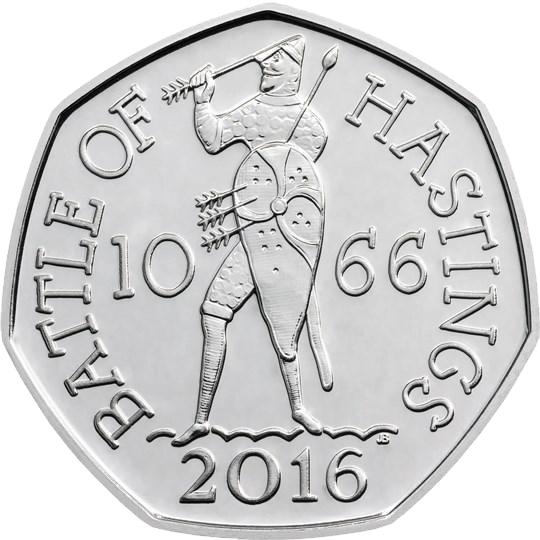
Artist Matthew Bonaccorsi faced quite the challenge when designing this coin - how do you capture the drama and complexity of medieval warfare on a canvas barely larger than a thumbnail? His solution was inspired: rather than attempt a realistic battle scene, he embraced the distinctive style of the Bayeux Tapestry itself. The coin's reverse shows Norman cavalry charging with couched lances, their distinctive kite shields and conical helmets rendered in the tapestry's characteristic linear style.
The genius lies in the details that tapestry enthusiasts will immediately recognise. The horses' flowing manes, the riders' chain mail, even the way the spears are positioned - everything echoes the medieval embroiderers' work. Around the edge, the inscription 'BATTLE OF HASTINGS 1066' anchors the design in history, while Queen Elizabeth II graces the obverse in Jody Clark's portrait. It's a design that works on multiple levels: instantly recognisable as currency, yet unmistakably connected to one of history's most famous artistic documents.
The genius lies in the details that tapestry enthusiasts will immediately recognise.
Obverse & reverse — click to flip
Chapter 3
Collector's Corner
Mintage
6,700,000
coins struck
Florin House Rarity
Uncommon
classification
Value
£1.00
estimated market
With 6.7 million coins minted, the Battle of Hastings 50p sits comfortably in that sweet spot collectors love - common enough to be affordable, yet scarce enough to feel special in your collection. You'll still find these turning up in general circulation, particularly if you're diligent about checking your change, though they're becoming less frequent as collectors and the general public alike recognise their appeal. The relatively modest premium over face value makes this an excellent entry point for new collectors interested in British military history.
What's particularly appealing about this coin is its crossover appeal. History buffs love it for obvious reasons, but it also attracts collectors of commemorative 50ps and those building sets around significant anniversaries. The coin's educational value shouldn't be underestimated either - it's a conversation starter that bridges nearly a millennium of history. While it may never reach the dizzy heights of some scarcer commemoratives, its combination of historical significance, attractive design, and reasonable accessibility makes it a solid addition to any collection focusing on British heritage.
It's a conversation starter that bridges nearly a millennium of history.
Chapter 4
Did You Know?
The Bayeux Tapestry isn't actually a tapestry at all - it's an embroidery, stitched with woollen threads on linen backing
King Harold was hit in the eye by an arrow during the battle, though modern historians debate whether this actually killed him
William the Conqueror brought over 7,000 horses across the English Channel for the invasion - a massive logistical undertaking for 1066
The battle site at Hastings is now marked by Battle Abbey, built by William on the exact spot where Harold fell
Explore this coin on Florin House
View detailed specifications, track its value, and add the Battle of Hastings to your collection.
View Battle of Hastings