Picture yourself checking your change after a coffee shop visit in 2007, and there it is—a £2 coin that stops you in your tracks. Not because of its value, but because of what it represents. This wasn't just another commemorative celebrating a royal birthday or sporting triumph. This was Britain acknowledging one of its darkest chapters while celebrating a moral awakening that began 200 years earlier.
Chapter 1
The Story Behind the Coin
In 1807, after decades of fierce parliamentary battles and tireless campaigning by abolitionists like William Wilberforce and Olaudah Equiano, Britain finally passed the Abolition of the Slave Trade Act. It was a seismic moment—not just for the British Empire, but for humanity itself. The act didn't end slavery immediately, but it marked the beginning of the end for the triangular trade that had brought such wealth to British ports while causing immeasurable suffering to millions of Africans.
By 2007, Britain was ready to confront this complex legacy head-on. The bicentenary wasn't just about patting ourselves on the back for being early abolitionists—it was about honest reflection on a trade that had enriched the nation while devastating countless lives. The Royal Mint's decision to commemorate this anniversary with a circulating £2 coin was bold, ensuring that this conversation wouldn't be confined to museums and history books, but would literally pass through millions of hands.
This was Britain acknowledging one of its darkest chapters while celebrating a moral awakening that began 200 years earlier.
YOU’RE INVITED!
Trade gold, silver, stocks & crypto on eToro
Joining through this invite supports Florin House. Capital at risk · T&Cs apply.
Chapter 2
The Design
Matthew Bonaccorsi faced an almost impossible task: how do you capture the weight of such a profound historical moment on a coin no bigger than a biscuit? His solution was both elegant and haunting. The reverse features the silhouette of a slave ship, its human cargo represented by a pattern of figures that speaks volumes without saying a word. Around this powerful image, the inscription 'ABOLITION OF THE SLAVE TRADE' curves like a proclamation of freedom itself.
What strikes you most about Bonaccorsi's design is what he chose not to include. There are no celebratory flourishes, no triumphant imagery—just the stark reality of what was being abolished. The ship sits heavy on the coin's surface, a reminder that commemoration sometimes means confronting uncomfortable truths rather than simply celebrating victories.
The ship sits heavy on the coin's surface, a reminder that commemoration sometimes means confronting uncomfortable truths rather than simply celebrating victories.
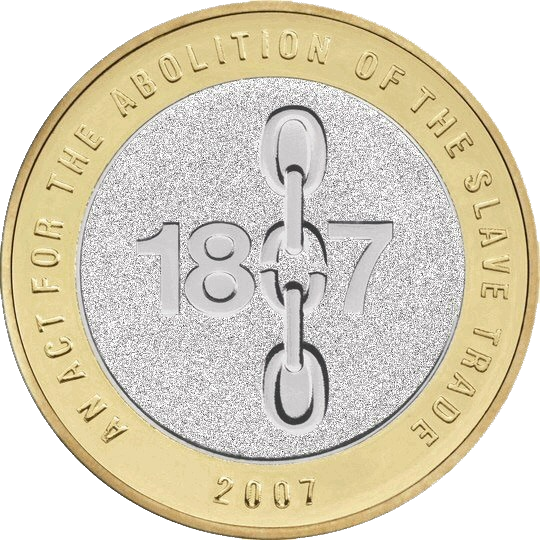
Obverse & reverse — click to flip
Chapter 3
Collector's Corner
Mintage
8,445,000
coins struck
Florin House Rarity
Uncommon
classification
Value
£2.00
estimated market
With over 8 million examples minted, this isn't the rarest coin you'll ever find, but that's rather the point. The Royal Mint wanted this message to reach as many people as possible, and in that sense, it succeeded brilliantly. You can still find examples in your change today, though pristine uncirculated versions are becoming increasingly sought after by collectors who appreciate coins with serious historical weight.
What makes this coin particularly appealing to collectors isn't its scarcity, but its significance. It represents a watershed moment in British commemorative coinage—perhaps the first time a circulating coin directly addressed such a morally complex aspect of the nation's history. Thematic collectors focusing on social justice, British colonial history, or simply important anniversaries consider this an essential piece for their collections.
It represents a watershed moment in British commemorative coinage—perhaps the first time a circulating coin directly addressed such a morally complex aspect of the nation's history.
Chapter 4
Did You Know?
This was one of the first British coins to directly acknowledge the darker aspects of the nation's imperial past
The Abolition of the Slave Trade Act didn't actually free existing slaves—it took another 26 years until the Slavery Abolition Act of 1833
William Wilberforce, the famous abolitionist, died just three days before the Slavery Abolition Act received royal assent
The triangular trade that this coin commemorates ending had made cities like Liverpool, Bristol, and London incredibly wealthy
Explore this coin on Florin House
View detailed specifications, track its value, and add the Abolition of the Slave Trade to your collection.
View Abolition of the Slave TradeWritten with AI assistance from the catalogue record for Abolition of the Slave Trade.